
DGE-AUC (Density Gradient Equilibrium Analytical Ultracentrifugation) is a high-resolution, label-free technique ideal for characterizing the density profile of complex, multi-component biologics, including adeno-associated virus (AAV), adenovirus (AdV), lentivirus (LV), other virus-like particles (VLPs), and lipid nanoparticles (LNPs).
With a large fleet of AUC instruments and dedicated team of AUC experts, BioAnalysis is uniquely positioned to help drug developers better characterize their products with a first principle approach that provides comprehensive data analytics to answer difficult regulatory questions.
Testing Principle

DGE-AUC method utilizes a self-generating gradient (e.g., cesium chloride or sucrose) to separate particles based on buoyant density in an analytical ultracentrifuge to monitor the migration of particles until they reach their isopycnic position.
DGE-AUC Features

High Resolution
Detect minor differences in capsid content or particle composition.

Multi-Wavelength Capability
Spectral deconvolution to evaluate protein, nucleic acid, and other components.

Minimal Sample Required
Ideal for early-stage material with limited or crude supply.

No Complex Modeling
Simple Gaussian analysis, no complicated analysis software.
What is DGE-AUC used for in AAV and Viral Vector Characterization?
DGE-AUC separates and quantifies empty, partially filled, and full AAV capsids by resolving differences in their buoyant densities. Although AAV capsids are nearly identical in size and shape, even small differences in packaged DNA produce measurable density shifts along a density gradient. DGE-AUC is analogous to preparative Density Gradient Ultracentrifugation (DGUC) and can be useful for informing purification protocols.
DGE offers great sensitivity to minor differences in nucleotide content and capsid heterogeneity, and it also remains serotype-agnostic, making it a powerful tool for deeper characterization of AAV heterogeneity. The technique also allows for deeper characterization of minor populations.
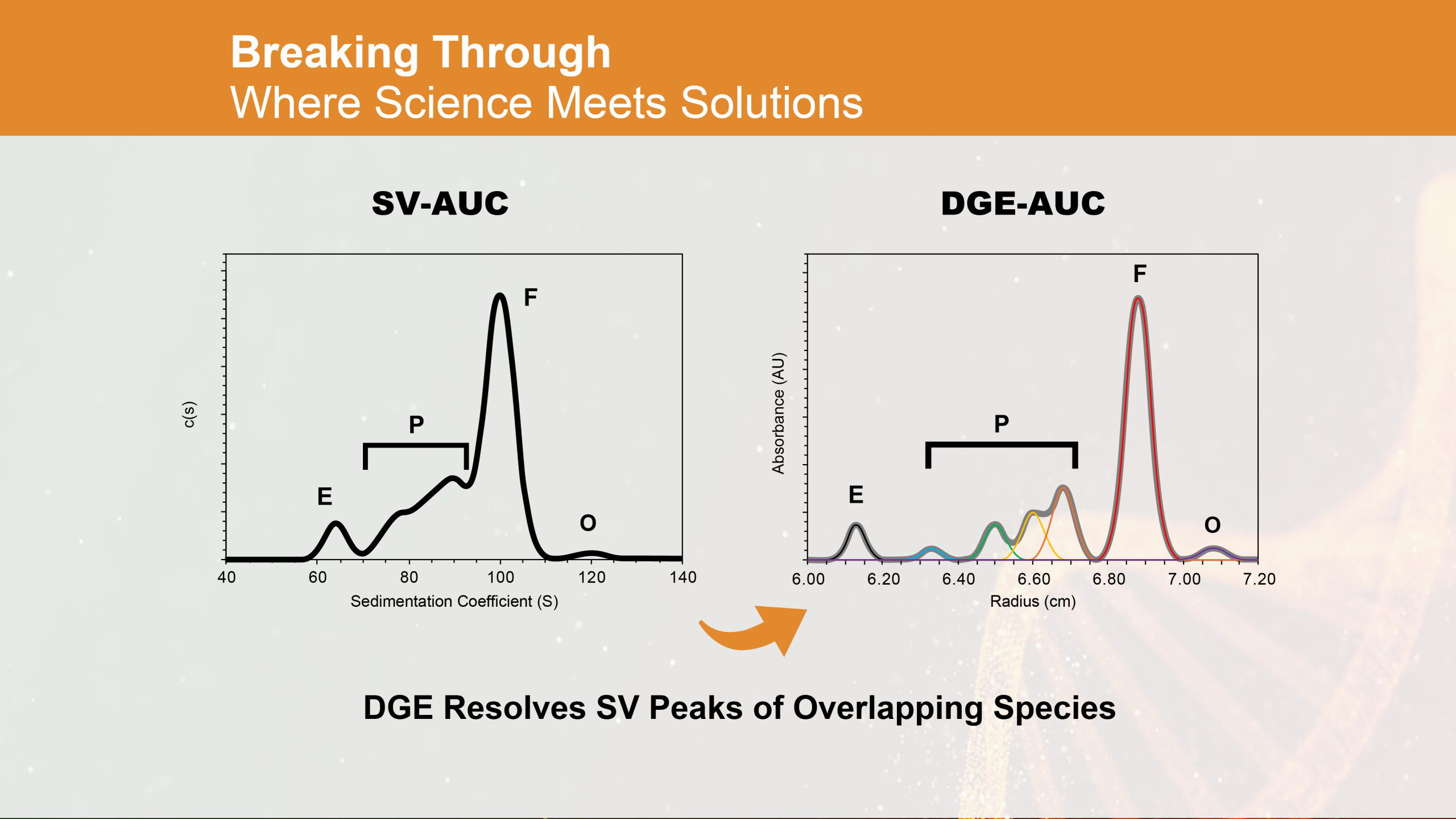
DGE-AUC resolves heterogeneity of empty, partial, and full capsids for Critical Quality Attributes (CQAs)
DGE-AUC separates viral capsid populations by buoyant density, a physical property distinct from the sedimentation coefficient that SV-AUC measures. Used alongside SV-AUC, DGE-AUC adds an orthogonal layer of resolution by distinguishing subpopulations within the partial capsid population, resolving genome-of-interest (GOI) length differences and separating overloaded capsids from dimers and other aggregated capsids. Developers can use DGE-AUC to assess capsid content, quantify aggregates, and characterize heterogeneity across the full capsid population.
The fraction of full capsids is widely regarded as a CQA for process development, regulatory filings, and lot release testing. Aggregates, overloaded, partially, and empty capsids are generally considered product- or process-related impurities that may raise safety and efficacy concerns. DGE-AUC is particularly valuable for resolving differences in GOI length and distinguishing overloaded capsids from dimers which can clarify ambiguous SV-AUC results without replacing SV-AUC as the primary method for empty, partial, full characterization.
At BioAnalysis, we have developed a novel approach to buoyant density and gene of interest (GOI) determination, pushing the boundaries of resolution achievable with this technique.
How can DGE-AUC be used to characterize Lipid Nanoparticles (LNPs)?
The buoyant density of LNP subpopulations is a useful attribute to distinguish between empty, partially loaded, and fully loaded nanoparticles. SV-AUC is sensitive to changes in particle density, as well as hydrodynamic size, resulting in a more detailed characterization than what bulk assays like DLS or RiboGreen assays are capable of providing. DGE-AUC allows for direct buoyant density measurements, while also supporting multiwavelength analysis. These two AUC methods may be used in conjunction with one another for thorough product characterization, including evaluation of aggregation and stability during formulation development under stress conditions including pressure and buffer changes or freeze-thaw cycles.
Although LNPs within a given formulation may be similar in size and surface chemistry, incremental nucleic acid content produces meaningful increases in particle density that can be translated to LNP cargo loading. The LNP density determines where each subpopulation equilibrates within the density gradient and resolves species that size-based methods such as DLS or SEC cannot distinguish.
Our clients often ask what their encapsulation efficiency (EE) number represents at the particle level and whether a high average EE% reflects a uniformly loaded population or masks a mixture of fully loaded and partially loaded particles in the same batch. Density gradient equilibrium and sedimentation velocity AUC are well-suited to provide deeper characterization of your LNP product and answer exactly that question.
Read More
Yarawsky AE, Cardenas Lopez P, Walter J, DeLion MT, Paul LN. A fundamental approach to buoyant density determination by DGE-AUC. Analytical Biochemistry. 2025;704:115907. doi:10.1016/j.ab.2025.115907
Hirohata K, et al. Applications and Limitations of Equilibrium Density Gradient Analytical Ultracentrifugation for the Quantitative Characterization of Adeno-Associated Virus Vectors. Analytical Chemistry. 2024;96(2):642-651. doi:10.1021/acs.analchem.3c01955
Why Choose BioAnalysis?

1. Scientific Excellence
Our team delivers rigorous methods and clear results.

2. Client Partnership
We work closely with your team, providing collaborative solutions tailored to your unique challenges.

3. Rapid Delivery
Efficient workflows and optimized processes ensure timely results without compromising scientific rigor.

4. Proven Track Record
Supporting numerous IND, BLA, and MAA applications with successful FDA/sponsor audits.
Breaking Through
Breaking through scientific barriers starts with breakthrough research. Explore how our published expertise delivers proven solutions for clients like you.
View all publications: bioanalysisllc.com/technical-hub
Ready to get started? Contact our team to discuss your DGE-AUC testing needs.